
Before You Fall in Love with the Land: What Every Dream Home Buyer Needs to Know
There's a particular kind of excitement that comes with finding "the lot"—that perfect piece of land where you can already picture your dream home taking shape. Maybe it's the mature trees, the view, the quiet street, or just a feeling that this is the place. It's easy to get swept up in that vision and want to move quickly.
But before you sign anything, it's worth slowing down. Buying vacant land or a teardown property to build your custom home is fundamentally different from buying an existing house, and it comes with risks that aren't always obvious at first glance—or even second glance. Your realtor is a valuable partner in this process, but realtors are not land-use experts, environmental consultants, or surveyors. Due diligence on a building lot is a specialized undertaking, and the responsibility for making sure it's done thoroughly ultimately falls on you, the buyer.
Here are a few of the issues that catch new home builders off guard most often.
But before you sign anything, it's worth slowing down. Buying vacant land or a teardown property to build your custom home is fundamentally different from buying an existing house, and it comes with risks that aren't always obvious at first glance—or even second glance. Your realtor is a valuable partner in this process, but realtors are not land-use experts, environmental consultants, or surveyors. Due diligence on a building lot is a specialized undertaking, and the responsibility for making sure it's done thoroughly ultimately falls on you, the buyer.
Here are a few of the issues that catch new home builders off guard most often.
Watercourses and drainage features you can't always see.
A creek, seasonal stream, wetland, or even a drainage ditch running through or near a property can trigger setback requirements from your local municipality or conservation authority. These setbacks, sometimes 15, 30, or even 50 meters from the top of a bank can dramatically shrink your usable building envelope. In some cases, a property that looks spacious on paper turns out to have most of its buildable area eaten up by a required buffer zone once you factor in a watercourse that barely shows up during a dry-season site visit. This is the kind of thing a conservation authority or municipal planning department can flag, but it rarely shows up in a standard listing.
Easements and rights-of-ways
Utility companies, neighboring landowners, and municipalities can hold legal rights to use portions of a property for things like buried pipelines, overhead power lines, shared driveways, or access to a landlocked parcel behind yours. These easements are registered on title, but they're not always obvious from a walk-through, and they can restrict exactly where you're allowed to place a foundation, a septic system, or even a driveway. A title search and a proper survey are essential to understand what you're actually free to build on.
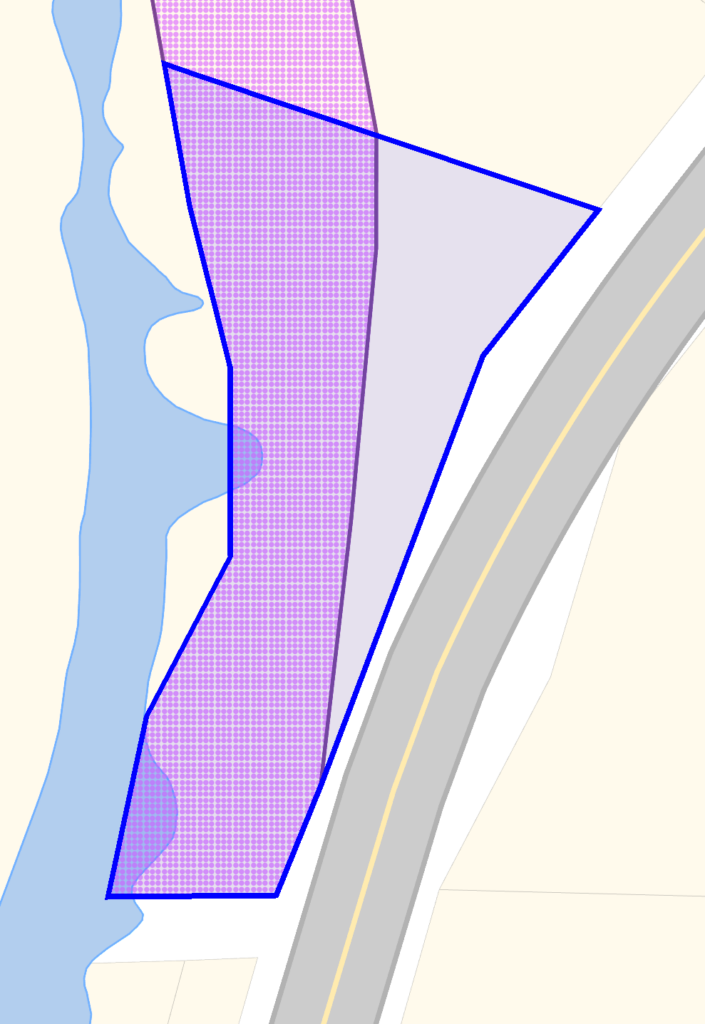
On the right is an image of a right-of-way in purple and a water course in blue. As you can see the buildable area for this property outlined in dark blue has limited areas to build a new home.
A creek, seasonal stream, wetland, or even a drainage ditch running through or near a property can trigger setback requirements from your local municipality or conservation authority. These setbacks, sometimes 15, 30, or even 50 meters from the top of a bank can dramatically shrink your usable building envelope. In some cases, a property that looks spacious on paper turns out to have most of its buildable area eaten up by a required buffer zone once you factor in a watercourse that barely shows up during a dry-season site visit. This is the kind of thing a conservation authority or municipal planning department can flag, but it rarely shows up in a standard listing.
Easements and rights-of-ways
Utility companies, neighboring landowners, and municipalities can hold legal rights to use portions of a property for things like buried pipelines, overhead power lines, shared driveways, or access to a landlocked parcel behind yours. These easements are registered on title, but they're not always obvious from a walk-through, and they can restrict exactly where you're allowed to place a foundation, a septic system, or even a driveway. A title search and a proper survey are essential to understand what you're actually free to build on.
On the right is an image of a right-of-way in purple and a water course in blue. As you can see the buildable area for this property outlined in dark blue has limited areas to build a new home.
Zoning restrictions on secondary structures
If your plans include a coach house, laneway suite, in-law suite, or workshop down the road, it's worth confirming early whether the zoning actually permits it. Some municipalities have specific bylaws around lot coverage, secondary suite eligibility, height restrictions, or minimum lot sizes that could make your long-term plans impossible on that particular parcel, even if the main home is perfectly viable.
A few other things worth checking
Soil conditions and the need for geotechnical testing, floodplain mapping, tree preservation bylaws, heritage designations, and the availability and cost of extending services like water, sewer, or hydro to the site can all significantly affect your budget and timeline.
The bottom line
None of this means you should be scared off a piece of land you love. It simply means that before you remove conditions or finalize a purchase, it's worth investing in a proper due diligence process: a title search, a survey, a conversation with the local planning department, and where relevant, a conservation authority review. A real estate lawyer and, if needed, a land-use planner or civil engineer can help you understand exactly what you're buying and what you can build.
The cost of that upfront research is small compared to discovering after closing that your dream home has to shrink, shift, or be redesigned entirely because of something that was there all along, just waiting to be found.
If you are looking for someone to help you provide this research you can purchase a P.A.R. Report
If your plans include a coach house, laneway suite, in-law suite, or workshop down the road, it's worth confirming early whether the zoning actually permits it. Some municipalities have specific bylaws around lot coverage, secondary suite eligibility, height restrictions, or minimum lot sizes that could make your long-term plans impossible on that particular parcel, even if the main home is perfectly viable.
A few other things worth checking
Soil conditions and the need for geotechnical testing, floodplain mapping, tree preservation bylaws, heritage designations, and the availability and cost of extending services like water, sewer, or hydro to the site can all significantly affect your budget and timeline.
The bottom line
None of this means you should be scared off a piece of land you love. It simply means that before you remove conditions or finalize a purchase, it's worth investing in a proper due diligence process: a title search, a survey, a conversation with the local planning department, and where relevant, a conservation authority review. A real estate lawyer and, if needed, a land-use planner or civil engineer can help you understand exactly what you're buying and what you can build.
The cost of that upfront research is small compared to discovering after closing that your dream home has to shrink, shift, or be redesigned entirely because of something that was there all along, just waiting to be found.
If you are looking for someone to help you provide this research you can purchase a P.A.R. Report